Imagine this: It’s the mid-to-late 2000s. You come home from school with your iPod Nano on shuffle and your Sidekick buzzing in your back pocket. You kick off your checkered Vans at the door, grab a (now probably frowned-upon) snack from the pantry, and head to your desktop to login into Myspace.
Becky flirted with the boy you like during gym, so you bump her out of your ‘Top 8’ to send a very clear message. You know it’ll spark some drama on AIM later—and maybe even provoke a subliminal Facebook status from Becky, complete with empowering lyrics followed by a peace sign emoji. Life is good…
Pretty wild to think millennials actually lived like this, huh?
But as we grew up, so did the platforms we loved. The ones that couldn’t graduate from their own digital high school phase? They didn’t make the cut. More specifically: Orkut—once Brazil’s leading social media platform during the height of the social media renaissance.
What Was Orkut?
Launched in 2004 by Google employee, Orkut Büyükkökten, Orkut was one of the hottest emerging platforms, especially in Brazil. Like its competition, it aimed to connect friends, share content, and foster exclusive online communities around shared interests and cultural values. Friends could even rate each other through testimonials based on metrics like how sexy, trustworthy, or cool they were. How about that for a friend hierarchy, Myspace?
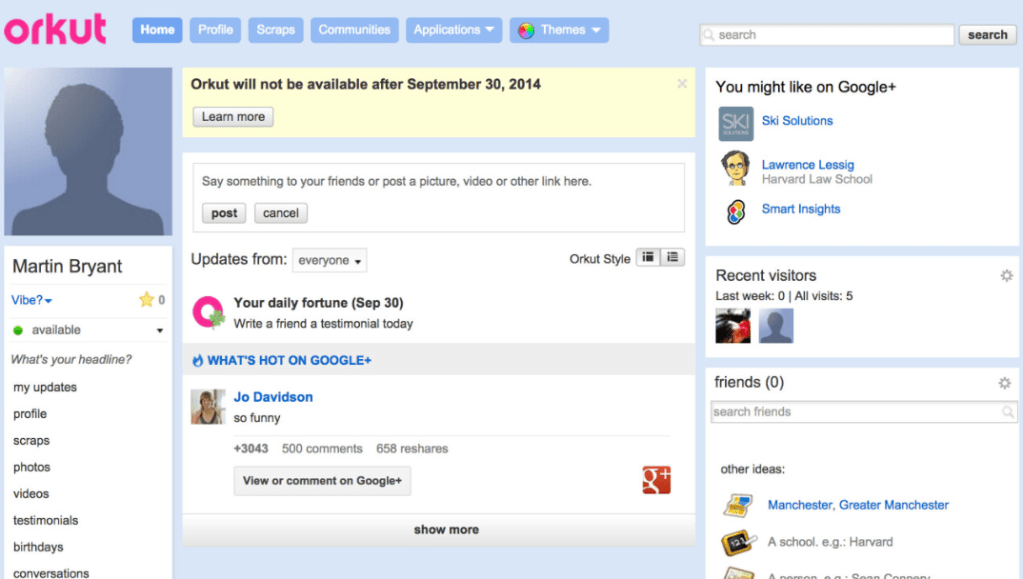
At its peak in 2012, Orkut boasted over 30 million users globally, with its strongest presence among Brazilians aged 18-25. The site was powered by Google, it had a clean interface, photo sharing, and vibrant user communities. It had most of the tools we now consider staples of social media.
So…why did it fail?
Social Media Beyond The Status Updates
These days, we don’t remove Becky from our Top 8—we support her Etsy shop. In other words, social media is no longer just for expressing ourselves. It’s for shopping, researching, and connecting with brands. Then, it’s to buy those brands and post pictures of them to make our friends jealous.
To show you just how embedded social media is in everyday consumer behavior (as of 2025), here are some insights from Sprout Social:
- 48% of consumers use social media to interact with brands
- Social media ads are the #1 driver of brand awareness for users aged 16 to 34
- Direct purchases are booming on social: Facebook (39%), TikTok (36%), and Instagram (29%)
- 49% of consumers buy products monthly because of influencer content
- 90% rely on social media to keep up with social trends and cultural relevance
Long gone are the days of only worrying about pending friend requests and oversharing on social media. These platforms are our libraries, our job boards, our shopping malls, our mere existence in digital form. Orkut couldn’t bridge the gap between the real and digital consumer experience. That’s no longer a luxury—it’s the cost of entry.
Out With The Old, In With The New

Now imagine this: you’re driving down a U.S. interstate and don’t see a single billboard. No ads on injury lawyers at CALL NOW: 111-1111. Just… trees. Sounds kind of dreamy, right?
Well, Brazil made it a reality in 2007. In a bold move to reduce “visual pollution” and the growing issue on overconsumption, the country banned billboards, posters, and street signage in major cities.
So where did the advertisers go?
You guessed it—social media.
While traditional media (TV, radio, print) still lingered, Brazilian consumer culture was already shifting online. People sought product info, reviews, and brand relationships through digital channels. Orkut, despite its unwavering potential, couldn’t deliver. It missed its moment—what could’ve been a turning point for social commerce in one of the most digitally engaged markets.
Learning From Failure
Orkut didn’t just fail because it missed out on emerging marketing trends—it failed because it didn’t evolve with its users. It clung to its own narrow idea of community without embracing new tools for functional content sharing, true participation, commerce, or cultural relevance.
Social media has never been about the companies behind the platforms. It has always been, and always will be, about the people using them.
We grow. We mature. We change, both individually and societally. Platforms that cannot change with us? Simply put, they will not survive.

 MikThoughts
Leave a comment